

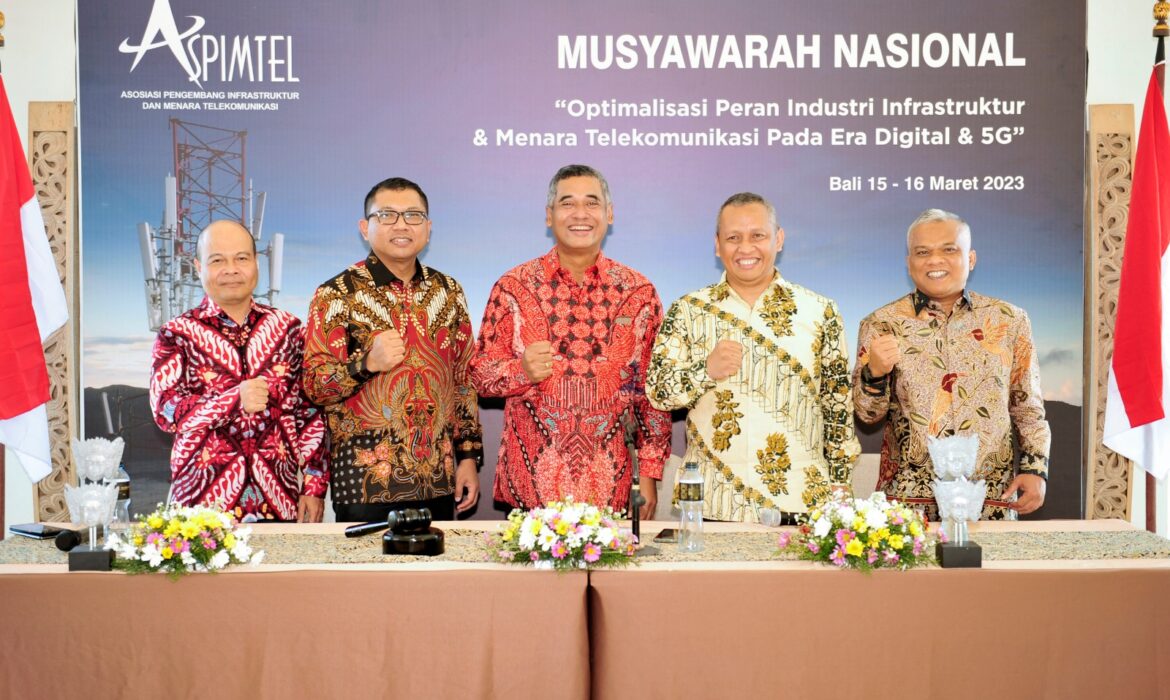
The Association of Telecommunications Infrastructure and Tower Developers (“ASPIMTEL”) held a National Conference (MUNAS) on March 15, 2023. Theodorus Ardi Hartoko, who is familiarly called Teddy Hartoko, was elected as General Chair of ASPIMTEL for the 2023-2026 period. The National Conference which was held in Bali took the theme “Optimizing the Role of the Infrastructure & Telecommunication Tower Industry in the Digital & 5G Era.” This is in line with ASPIMTEL’s vision and mission which is to help develop and accelerate the achievement of the digital and 5G era.
As stated by the President of the Republic of Indonesia, Mr. Joko Widodo, the development of Indonesia’s digital economy and industry 4.0 is the fastest in Southeast Asia and will be a strength for Indonesia to realize its vision. The digital economy in Indonesia and Industry 4.0 are estimated to contribute to Indonesia’s Gross Domestic Product (GDP) reaching USD 133 billion in 2025. This industrial progress will lead Indonesia to reach the top ten global economic powers by 2030.
The optimization of digital economic transformation is essential because it serves as a catalyst of economic growth in Indonesia. Indonesia’s digital economy is projected to expand 20% from 2021 to reach USD 146 billion by 2025 and is predicted to continue to increase (Ministry of Finance, 2022). Currently, the contribution of Indonesia’s digital economy is still relatively small to the national economy, but its rapid growth is evident.
To support this objective and make Indonesia a significant player in the global digital economy, the government needs to refine national infrastructure development policies. This entails not only the development of land and sea infrastructure, but the infrastructure supporting digital economic activities also needs support from the government. This was marked by the enactment of an omnibus law known as the Job Creation Law.
The advent of telecommunications towers has unwittingly contributed to meeting the need for cellular data services and ensuring connectivity as the keyelement in digital economic activities. Telecommunication towers are the fundamental requirement to ensure that the signals emitted by Base Transceiver Station (BTS) devices can reach the widest possible community.
Teddy Hartoko, the newly inaugurated General Chair of ASPIMTEL for the 2023-2026 term at the ASPIMTEL National Conference on March 15 2023, emphasized that Indonesia has significant potential in fostering the digital economy. This potential is evident in the rapid growth of data service usage. The existence of telecommunications towers is equally substantial in establishing connectivity for other digital economies, such as toll roads, electricity substations, and other vital infrastructure, particularly in preparing the 5G era. To support the acceleration of 5G implementation in Indonesia, apart from spectrum readiness, mobile operators and devices, telecommunications towers are an inseparable part of the 5G ecosystem. Therefore, the presence of telecommunications towers signifies a crucial milestone in terms of adopting 5G technology and encouraging improvements in quality, productivity, and automation in industrial operations. What’s more, it serves a substantial role in navigating the government’s initiative namely Making Indonesia 4.0 to success.
On the same occasion afterwards, Rudolf Nainggolan, serving as President Director of PT. Gihon Telekomunikasi Indonesia, Tbk. (Gihon), was appointed as Deputy General Chair. Meanwhile, Indra Gunawan serves as Director of PT. Sarana Menara Nusantara, Tbk. (Protelindo) as Secretary General.
Teddy Hartoko, who currently also serves as President Director of PT. Dayamitra Telecommunications, Tbk. (Mitratel) is committed to bringing ASPIMTEL play an influential role in supporting the central and regional governments in the establishment of telecommunications tower infrastructure through 3 aspects.
The first is the business aspect, Infrastructure Providers, especially towers, must immediately transform into digital infrastructure providers or beyond tower providers. This will develop the telecommunications infrastructure industry in Indonesia in a sustainable manner.
Second is the regulatory aspect, ASPIMTEL is committed to coordinating and communicating with the Central and Regional Governments in overseeing the progress of infrastructure and telecommunications towers. The goal is for the government to design straightforward regulations that can be implemented and disseminated across the entire community, emphasizing the importance of telecommunications towers in fostering the growth of the digital economic industry in all regions of Indonesia.
Third is the environmental aspect, development and establishment of infrastructure must give positive contributions on environmental sustainability, including the use of technology to reduce carbon emissions (green energy) and the use of environmentally friendly materials to promote sustainable growth.
“The ASPIMTEL program in the future must be able to fulfill the 3 aspects above to bolster the growth of the digital economy industry efficiently and evenly throughout Indonesia”.


Telkom Landmark Tower, Lantai 25-27
Jl. Gatot Subroto Kav. 52 Jakarta, 12710, Indonesia

mitratel@mitratel.co.id
fax: 021 2277 0817
PT Dayamitra Telekomunikasi Tbk. or Mitratel is a subsidiary of PT Telkom Indonesia (Persero) Tbk which is engaged in telecommunications infrastructure.
© 2021 — PT Dayamitra Telekomunikasi Tbk.